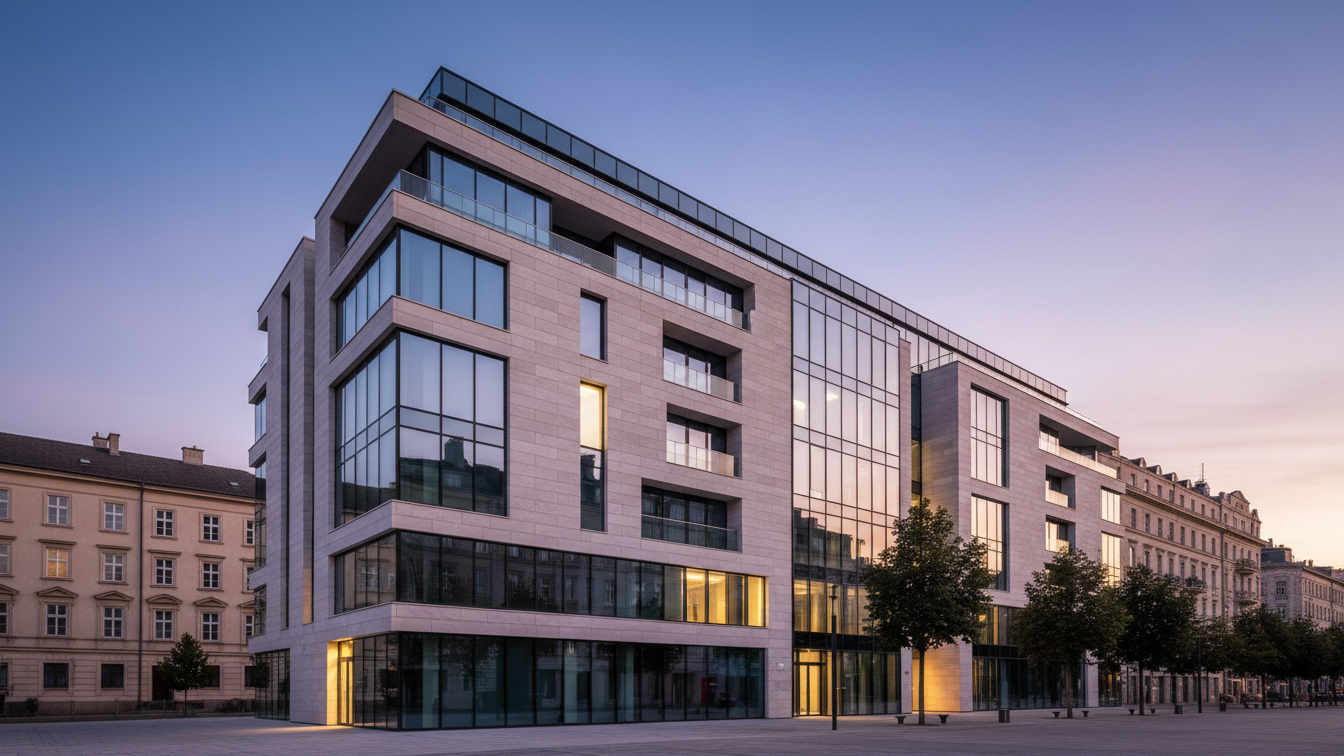
Despite the shift in the interest rate environment and higher financing costs, residential property continues to maintain its position as a central cornerstone for long-term wealth accumulation. Industry representatives reaffirmed this during an online specialist conference on the importance of residential investments. While experienced investors are increasingly looking at existing properties with moderate entry prices, declining-balance depreciation options and state-subsidised loans in the energy-efficient new-build segment are unlocking noticeable return advantages for private investors.
According to Ulrich Creydt, tax advisor and partner at Ypsilon GmbH, an investor's journey typically divides into initial wealth accumulation, subsequent retirement provision, and the orderly transfer of assets to future generations. Those who enter early with smaller residential units often expand their portfolio to multi-family properties. In addition, Philip C. Hetzer, Managing Partner at DAHLER Invest, points to growing demand from young founders in the start-up sector who invest proceeds at an early stage into multi-family as well as mixed-use residential and commercial buildings in order to secure predictable income and long-term asset value.
Tax incentives and subsidised loans in the new-build segment
The combination of declining-balance depreciation and special depreciation under Section 7b of the German Income Tax Act (EStG) for the KfW 40 QNG standard unleashes significant leverage for newly built apartments. Creydt illustrates this with a 50-square-metre flat priced at 305,000 Euro: assuming a building share of 75 per cent, depreciation potential of around 24,500 Euro arises in the first year. In addition, low-interest KfW funds amounting to 150,000 Euro per unit provide a particular benefit for smaller floor plans.
A calculation by Strategis AG for the Berlin project Thule 48, located on the border between Pankow and Prenzlauer Berg and comprising 78 predominantly compact two-room apartments, highlights the scale of these interest savings. With a KfW interest rate of 1.96 per cent compared to a market rate of 4.25 per cent, the annual interest benefit stands at 3,435 Euro. Michael Elst, Management Board member at Strategis AG, stresses that prospective buyers are increasingly seeking compact floor plans due to restricted budgets. Reliable developer warranties and predictable maintenance costs, combined with tax incentives, can facilitate after-tax equity returns that at times reach double digits.
Freehold plot divisions and commuter belt potential
Investment opportunities are by no means limited to dense inner-city locations. In the commuter belts of metropolitan areas, individually surveyed and partitioned new-build properties are gaining traction, as demonstrated by the development project from First Home Wohnbau GmbH in Beelitz, Brandenburg. The subsidiary of immobilien-experten-ag. is opening up a 33,000-square-metre site with semi-detached and terraced house structures, of which 15 semi-detached units are earmarked for private investors.
Mareike Lechner, Management Board member at immobilien-experten-ag., puts the total investment volume for the units, which offer 121 and 141 square metres of living space respectively, at 604,800 Euro and 714,000 Euro including ancillary and development costs. Assuming an equity stake of 20 per cent, corresponding to 120,960 or 142,960 Euro, and monthly net cold rents of 1,800 to 2,115 Euro, around 38 per cent of the invested equity is recouped via tax refunds within five years at a marginal tax rate of 42 per cent.