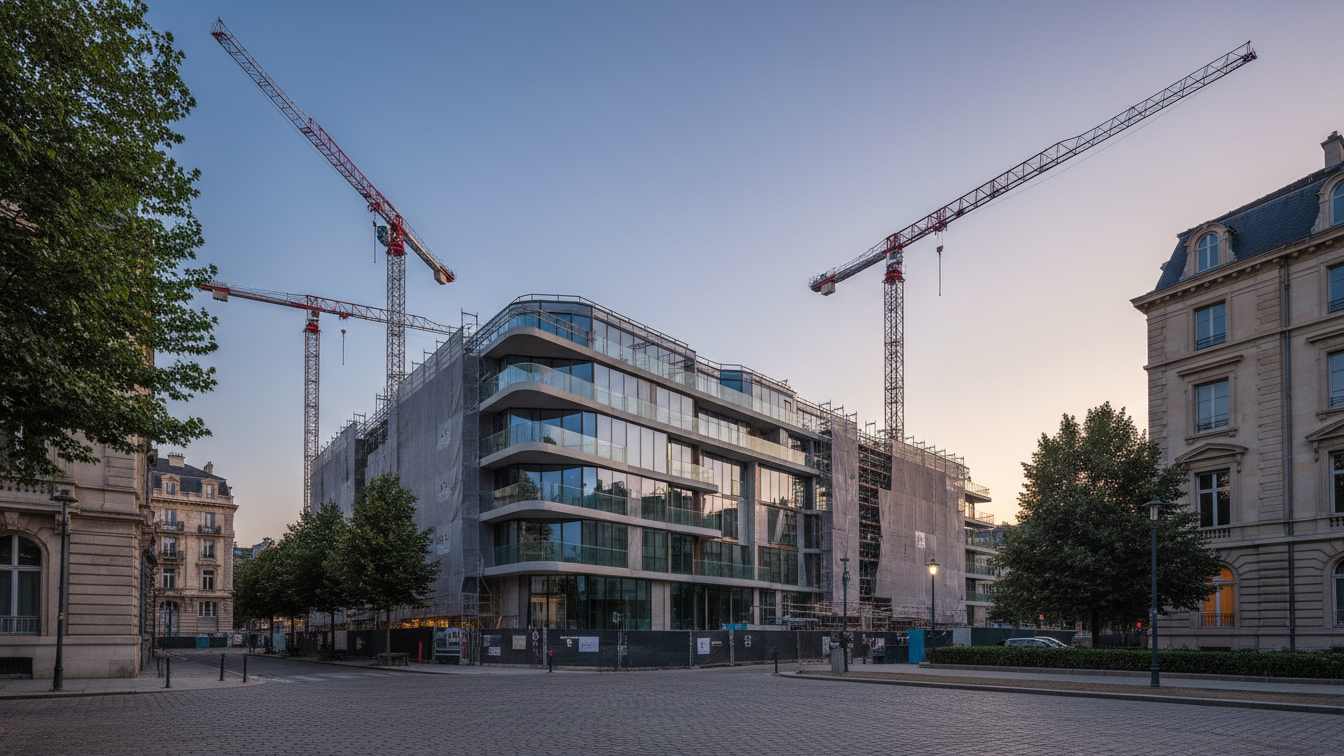

Since the entry into force of the so-called construction turbo on 30 October 2025, cities and municipalities have had broader legal scope to significantly accelerate planning and approval processes for residential construction. An initial interim review by the Federal Ministry for Housing, Urban Development and Building (BMWSB) now proves, on the basis of continuous data monitoring, that these instruments are meeting with a tangible response in municipal practice.
Around 400 municipalities took part in the survey. In 72 per cent of these cities and municipalities, concrete negotiations over applications based on the special provision have already taken place. More than half of the submitted projects have already received official approval. Between January and June 2026, the delivery of a total of 7,892 residential units was approved in this way.
Focus on infill development and existing sites
The statistical analysis illustrates that the procedural facilitations are predominantly being utilised for internal urban development. Almost nine out of ten of the approved residential units are being created on previously used sites, including vacant plots, commercial and mixed-use areas, vacant properties and urban brownfield land. Only around 12 per cent of the approved homes are located on former greenfield or agricultural land. In addition, approximately 84 per cent of the schemes involve multi-storey residential development in apartment blocks, complemented by targeted building additions and conversions of existing stock.
With regard to the findings, Federal Building Minister Verena Hubertz stressed that construction projects could be approved up to twenty times faster than before through the instrument. Practice showed that the focus was not on urban sprawl in outlying areas, but rather that valuable land resources were being preserved by using existing structures more efficiently and tapping into densification potential.
Scientific monitoring and testing in model municipalities
To support application within administrative authorities, the ministry has established a so-called implementation lab. Practical guidance and guidelines are being drawn up in cooperation with the Federal Institute for Research on Building, Urban Affairs and Spatial Development (BBSR), the German Institute of Urban Affairs (Difu), the Federal Association for Housing and Urban Development (vhw) and Forward Planung und Forschung GmbH.
- —Metropolises facing severe settlement pressure: Munich and Frankfurt am Main
- —Large and medium-sized cities with specific transformation tasks: Duisburg, Kiel, Trier and Ratingen
- —Municipal representatives in surrounding regions and rural areas: Rüdersdorf near Berlin and the district of Nienburg (Weser)
In these eight selected model municipalities, concrete use cases are being examined in depth in order to reconcile the acceleration of planning procedures with high urban design standards. Together with the ongoing monitoring, the insights gained will form the basis for the statutory evaluation of Section 246e of the German Building Code (BauGB) by 31 December 2029 and are intended to feed into future modernisations of urban planning law.